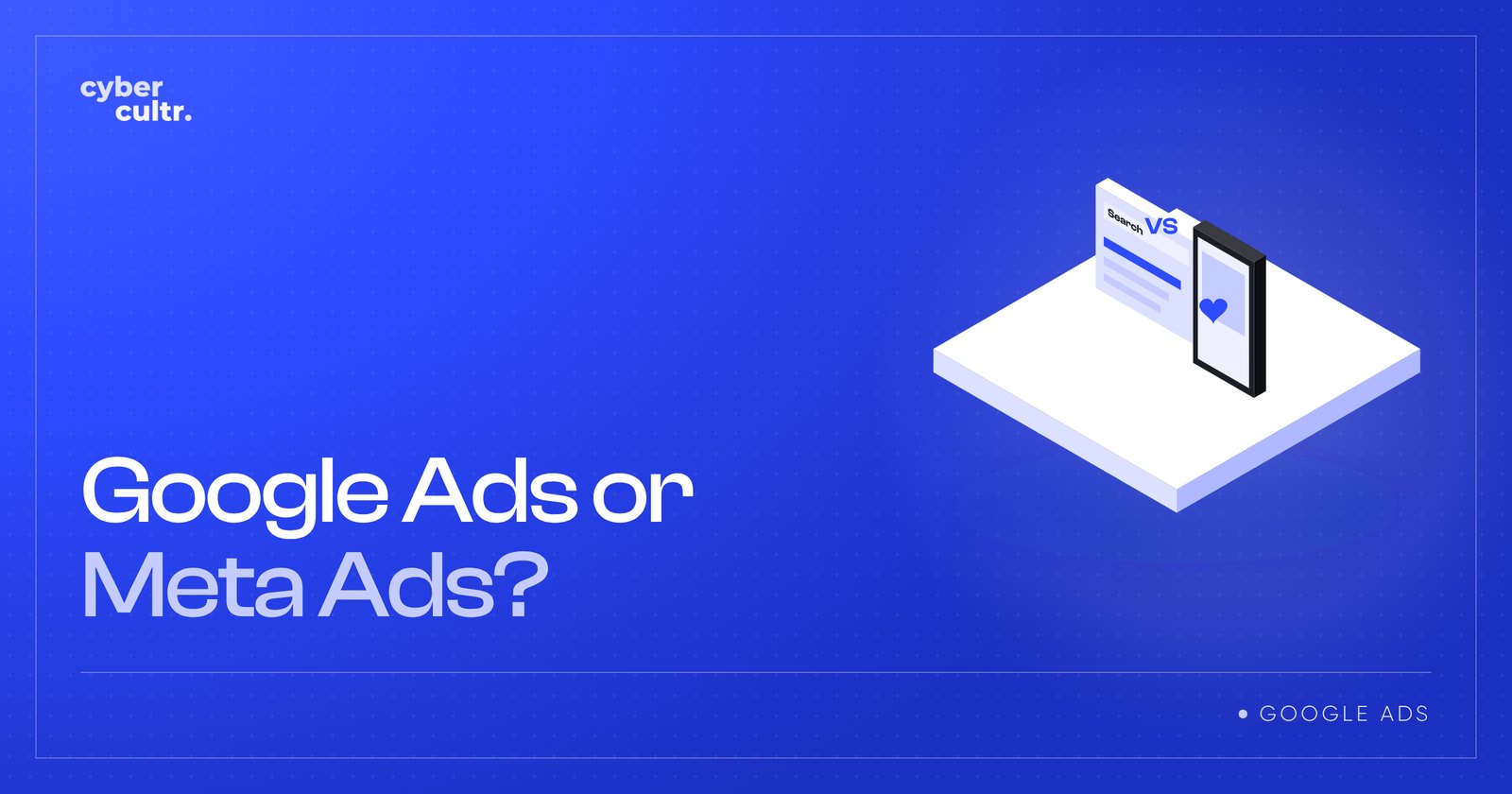
"Should we be on Google or Instagram?" is one of the first questions business owners ask us, usually with a limited budget and a lot riding on getting it right. It’s a fair question. But it’s a bit like asking whether you need a shop window or a salesperson. They do different jobs.
This article compares Google Ads and Meta Ads (Facebook and Instagram) for businesses in the UAE: how each one works, what each is good and bad at, and how to decide where your first dirham goes. It’s part of our series on paid advertising in the UAE.
The one difference that matters most
Google Ads captures demand that already exists. Someone types "dentist near me Jumeirah" or "corporate lawyer Dubai". They have a need, right now, and they’re actively looking. Your ad appears at the moment of intent.
Meta Ads creates demand. Someone is scrolling Instagram, not looking for anything. Your ad interrupts them with something they didn’t know they wanted: a new abaya collection, a padel club opening near them, a skincare routine. You’re starting the conversation.
Everything else flows from this. Costs, lead quality, creative, how fast you see results. Once you understand which kind of demand your business relies on, the decision gets much easier.
Google Ads: strengths and weaknesses
Where Google Ads shines
- High intent. People searching for your service are often ready to act. That usually means better lead quality.
- Fast results. A well-built search campaign can start generating enquiries within days.
- Measurable. You can see which keywords lead to calls and enquiries.
- Great for urgent or considered purchases. Emergency services, legal, medical, B2B, real estate, education, car services.
- Local targeting. You can target specific areas of Dubai, Abu Dhabi or Sharjah, and use location extensions and calls.
Where Google Ads struggles
- No search volume, no ads. If nobody searches for what you sell, there’s nothing to show your ad against.
- Competitive keywords get expensive. In crowded UAE categories like real estate, legal and aesthetics, cost per click can be high.
- Less room for brand building. A search ad is a few lines of text. It’s not where you tell your story.
- It needs a strong landing page. High-intent traffic still leaves if the page disappoints. See your Google Ads aren’t failing, your landing page is.
Google Ads also includes YouTube, Performance Max, Display and Shopping. These behave more like Meta, reaching people who aren’t actively searching. When we say "Google Ads" in this comparison, we mostly mean search.
Meta Ads: strengths and weaknesses
Where Meta Ads shines
- Reach and scale. Instagram and Facebook are part of daily life for most people in the UAE.
- Visual products. Fashion, beauty, food, interiors, hospitality and events look good in a feed and sell well there.
- Creating demand. New products, new venues, new categories that people don’t know to search for yet.
- Lower cost per impression. You can reach a lot of people for the budget.
- Retargeting. Showing ads to people who visited your site, watched your videos or engaged with your page.
Where Meta Ads struggles
- Lower intent. People weren’t looking for you, so more of them are curious rather than ready.
- Lead quality can vary a lot. Instant forms make enquiring very easy, sometimes too easy. We explain the trap in cheap leads are the most expensive thing you’ll buy.
- Creative-hungry. Ads fatigue quickly. You need a steady supply of fresh images and videos.
- Harder for some B2B and serious services. Not impossible, but it takes more work to get right.
If your Meta campaigns are already running and the results disappoint, 7 reasons your Facebook and Instagram ads are burning your budget is worth a read.
Side-by-side comparison
| Google Ads (Search) | Meta Ads | |
|---|---|---|
| Type of demand | Existing (people searching) | New (people scrolling) |
| User intent | High | Lower, varies |
| Speed to results | Fast | Fast to reach, slower to convert |
| Cost per click | Often higher | Often lower |
| Lead quality | Usually higher | Varies, needs filtering |
| Creative needs | Text, extensions, landing page | Images, video, a steady supply |
| Best for | Services, urgent needs, B2B, local | Visual products, new launches, lifestyle, retargeting |
Which industries suit which platform?
These are tendencies, not rules. We’ve seen exceptions in every category.
Usually Google first
- Clinics and medical services
- Legal, accounting and business setup firms
- Real estate (for active buyers and tenants)
- Car rental, repairs and services
- B2B services and logistics
- Education, training and courses
- Home services: cleaning, AC repair, pest control, movers
Usually Meta first
- Fashion, abaya labels and accessories
- Beauty, skincare and perfume
- Restaurants, cafes and hospitality
- Events, exhibitions and venues
- Gyms, padel and fitness
- New consumer products and launches
Usually both, early
- Aesthetics clinics (people search for treatments, and also respond to visual content)
- Real estate developers (search for active buyers, Meta for launches and awareness)
- E-commerce stores with a clear product category
- Education (search for "MBA Dubai", Meta for awareness and retargeting)
How to decide where your budget goes first
Ask these four questions in order.
- 1Do people already search for what I sell? Use the Google Ads Keyword Planner to see if there’s search volume for your service in your area. If there’s healthy volume, Google is a strong first step.
- 2Is my product visual, emotional or new? If it looks good, makes people feel something, or is something people don’t know to search for, Meta is a strong first step.
- 3How much budget do I have? A small budget spread across two platforms often means neither gets enough data to work. Better to do one properly. Our guide to how much to spend on digital advertising in Dubai helps you work out a starting number.
- 4Can I produce the creative? Meta needs fresh images and video regularly. If you can’t supply them, Google Search may be easier to run well.
Why most businesses end up using both
Once the first platform is working, the two tend to feed each other.
- Meta builds awareness and gets people interested.
- Those people later search for your brand name or category on Google.
- Google captures them at the moment they’re ready.
- Retargeting on Meta brings back the ones who visited but didn’t enquire.
This is why judging each platform separately can mislead you. Meta might not get the "last click" credit, but it may be why people searched for you in the first place. Look at the total picture: how many customers did you get, and what did it cost overall?
Common mistakes on each platform
Google Ads mistakes
- Using broad match keywords without negative keywords.
- Sending traffic to the homepage instead of a focused landing page.
- Not tracking phone calls, which are often the main way people enquire.
- Bidding on your own brand name without checking whether you need to.
- Letting Performance Max run without good conversion data.
Meta Ads mistakes
- Boosting posts instead of running proper campaigns with a clear goal.
- Running the same creative for months.
- Using instant forms with no qualifying questions.
- Not installing the Conversions API, so Meta can’t see who actually bought.
- Judging results only by the cost per lead, not by how many leads became customers.
The honest answer
There’s no universal winner. Google Ads is better when people are looking for you. Meta Ads is better when you need people to discover you. The best choice is the one that matches how your customers actually buy, and the strongest accounts usually use both, each doing the job it’s good at.
FAQs
Is Google Ads more expensive than Meta Ads in the UAE?
Cost per click is often higher on Google, especially in competitive categories. But the clicks are usually higher intent, so cost per customer can end up similar or lower. Compare platforms on cost per customer, not cost per click.
Can I run Meta Ads for a B2B business?
Yes, but it needs a different approach: tighter targeting, valuable content like guides or case studies, retargeting, and patience. Google Search and LinkedIn are often stronger starting points for B2B.
Should I advertise in Arabic as well as English?
If a meaningful share of your customers prefer Arabic, yes. On both platforms, separate campaigns or ad sets for each language usually perform better than mixing them.
Is TikTok an alternative to Meta?
For some audiences, especially younger ones and certain consumer products, TikTok can perform very well. It works more like Meta than Google, creating demand rather than capturing it.
Need help choosing?
We manage both Google Ads and Meta and social advertising for UAE businesses, so we don’t have a reason to push one over the other. If you’d like an honest recommendation for your business, book a free call to see if we’re a good fit.